



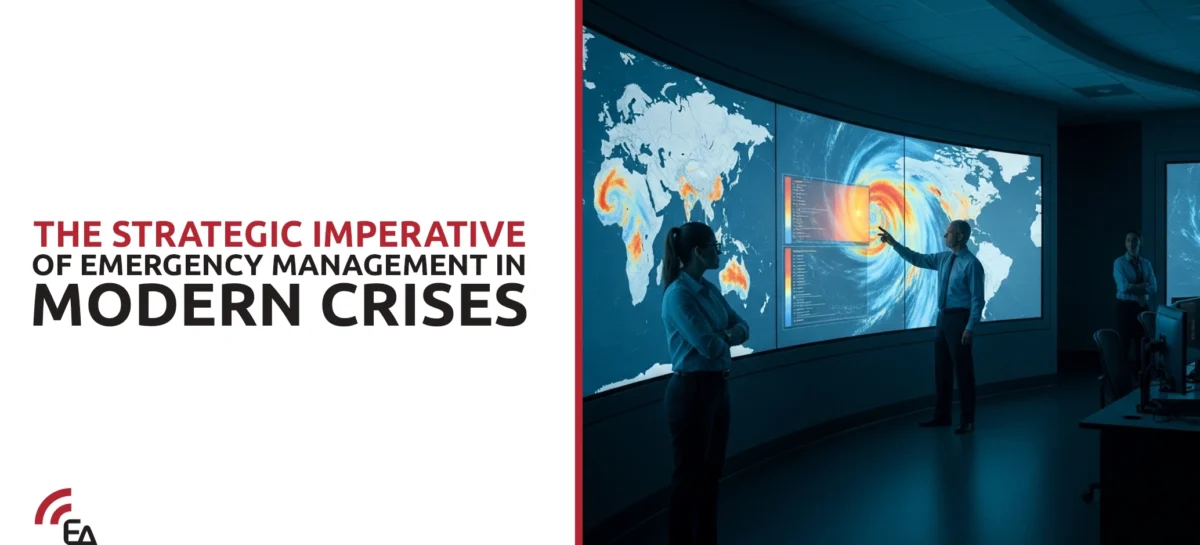
Leadership today exists within an ecosystem defined by volatility. From cyber intrusions and environmental disruptions to geopolitical instability and operational failure, crises arrive faster, interact more deeply, and unfold under greater scrutiny than ever before. Modern executives face an unrelenting equation of visibility, accountability, and speed, a landscape where the margin for delayed or fragmented response has all but disappeared.
For boards and CEOs, performance is now measured not only by growth but by the capacity to sustain operations under duress. Markets, investors, and regulators increasingly assess leadership on resilience as much as revenue. Every minute of indecision carries strategic cost, and every misstep in coordination can ripple across supply chains, customer confidence, and brand integrity.
In this climate, emergency management has evolved from a back-office protocol into a front-line leadership instrument. Its role extends beyond incident response; it defines how enterprises anticipate, structure, and execute under pressure. As crisis complexity intensifies, the ability to lead with foresight and composure has become a defining attribute of successful organizations, one that begins with disciplined, enterprise-wide emergency management readiness.
Redefining the Role of Emergency Management
Emergency management once operated as a procedural response mechanism, a structured reaction to incidents as they occurred. That model no longer matches the speed or interconnectedness of the modern risk environment. Today, emergency management functions as an enterprise-wide coordination system that connects leadership intent, operational execution, and organizational resilience.
The new standard is all-hazard emergency management; a unified approach that integrates every form of disruption into one operational logic. Whether a data breach, a wildfire, or a global supply chain disruption, the framework remains consistent: anticipate, mobilize, and adapt. It brings together the disciplines of business continuity, crisis communications, security, and governance under a single command philosophy.
Forward-leaning organizations view emergency management not as compliance, but as capability. It strengthens decision-making architecture, supports ESG commitments, and ensures that leadership can act from a position of knowledge, not reaction. This integration elevates readiness from an operational priority to a strategic one, a framework for leadership agility that defines competitive advantage in unpredictable times.
Through this evolution, emergency management has become not just about surviving crises but leading through them, setting the tone for governance maturity and long-term resilience.
The All-Hazard Emergency Management Model
The modern crisis environment has no boundaries. A regional flood can disrupt global logistics; a cyber incident can paralyze essential infrastructure; civil unrest can influence markets across continents. These cascading effects have made all-hazard emergency management a strategic necessity for organizations operating at scale.
The all-hazard model views risk as a network, not a list. It considers the full spectrum of potential threats — natural, technological, operational, and human — and maps how one hazard can trigger or magnify another. Instead of preparing for isolated events, enterprises build adaptive systems capable of managing complexity in motion.
At its core, the model depends on predictive intelligence, scalable command structures, and shared situational awareness. By connecting real-time data with standardized protocols, leaders can coordinate faster, validate priorities, and maintain control even when disruptions overlap. This integrated approach eliminates the silos that once slowed response, replacing fragmented reactions with cohesive orchestration.
Its credibility is reinforced through alignment with global standards such as ISO 22320, NFPA 1660, and the National Incident Management System (NIMS). Each reinforces the principle that readiness is measurable and governance-driven. In practice, all-hazard frameworks allow enterprises to transition from defensive reaction to proactive anticipation, transforming emergency management into a core component of enterprise risk governance.
The SME-Driven Advantage
In high-stakes crises, technology delivers information, but people create meaning. Even the most advanced predictive systems depend on interpretation to guide decisive action. That interpretive layer is provided by experts; individuals whose experience transforms data into strategy. This is the essence of SME-driven emergency management, where subject matter expertise defines clarity when automation reaches its limits.
Subject matter experts serve as the connective link between systems and decisions.
- They validate intelligence, distinguishing real threats from background noise.
- They translate analysis into action, ensuring decisions align with both technical accuracy and organizational priorities.
- They guide executive coordination, helping leadership teams manage uncertainty with composure and focus.
This combination of expertise and structure produces the rarest advantage in modern crisis response: confidence under pressure. When leaders can trust the information, they receive and the interpretation behind it, they act with precision rather than hesitation.
EarlyAlert’s approach exemplifies this integration. Its teams of seasoned professionals combine analytical rigor with operational experience, supporting executives in every phase of crisis management. The result is an emergency management framework where human intelligence refines technological capability, a partnership that ensures resilience remains both intelligent and instinctive.
In a landscape defined by complexity, expertise remains the compass that keeps leadership aligned with clarity.
Building Enterprise Resilience Through Unified Systems
Enterprise resilience is strongest when information, coordination, and response operate in concert. During crises, the organizations that recover faster are those whose systems speak the same language, where continuity, communications, and risk management converge through shared intelligence. All-hazard emergency management creates this alignment by integrating technology, human processes, and decision frameworks into one dynamic command environment.
In this ecosystem, field intelligence, data platforms, and executive command are interlinked. Real-time visibility replaces fragmented communication, giving leaders a live operational view of what is happening across sites, departments, and partners. This synchronization accelerates response and minimizes confusion when the pressure is at its peak.
Emergency preparedness and response services serve as the backbone of this structure. They ensure that plans, resources, and communications are coordinated before disruption strikes. Together, these systems enable interoperability, the ability for every stakeholder, from field teams to the boardroom, to operate from the same situational picture.
Integration turns emergency management from an administrative requirement into a performance multiplier. It transforms readiness into a measurable asset, where decision velocity, coordination accuracy, and outcome stability define the true strength of enterprise resilience.
Governance, Accountability, and the Metrics of Readiness
Resilience has moved from the operations floor to the board agenda. Regulators, investors, and oversight bodies now evaluate crisis preparedness as an indicator of governance maturity. Executives are expected not only to plan for emergencies but to prove readiness with verifiable performance data. All-hazard emergency management provides the structure and transparency needed to meet this expectation.
The modern governance model of emergency management is anchored in measurable outcomes.
- Response time: The interval between detection and coordinated action.
- Coordination efficiency: The degree to which information flows without duplication or delay.
- Recovery cost reduction: The ability to minimize financial and reputational losses through rapid restoration.
These metrics transform preparedness into a quantifiable standard. Lifecycle tracking ensures every phase of a crisis—planning, response, recovery, and review—is auditable. That data supports ESG reporting, investor confidence, and executive accountability.
In mature organizations, emergency management now sits alongside financial controls, cybersecurity, and compliance as a core pillar of governance. It signals discipline, foresight, and integrity. When readiness is transparent and auditable, it strengthens not only operational continuity but also institutional trust.
Turning Uncertainty into Command Capability
Moments of crisis reveal more than weaknesses in systems; they reveal the character of leadership. In a global environment defined by constant disruption, the most valuable executive capability is composure backed by structure. Emergency management provides that structure, it gives leadership a disciplined framework for coordination, communication, and control when the unexpected occurs.
Every critical decision made in a crisis shapes reputation, confidence, and internal culture. C-suite teams that invest in readiness don’t just manage events; they define how their organizations will be remembered afterward. The ability to anticipate, adapt, and guide teams through uncertainty builds credibility not only with employees but also with customers, regulators, and investors.
At its highest level, SME-driven emergency management becomes leadership infrastructure. Subject matter experts enable leaders to focus on strategic direction while ensuring that operational precision never falters. This partnership between executive intent and technical command creates an environment where clarity replaces confusion and strategy guides every action. In today’s environment, leadership excellence and emergency management capability have become inseparable.
Partner with EarlyAlert to discover how SME-driven emergency management and all-hazard emergency preparedness and response services empower global enterprises to anticipate, coordinate, and recover with confidence.
Equip your leadership teams with the foresight, structure, and expertise to lead through uncertainty and strengthen resilience for the challenges ahead.


