



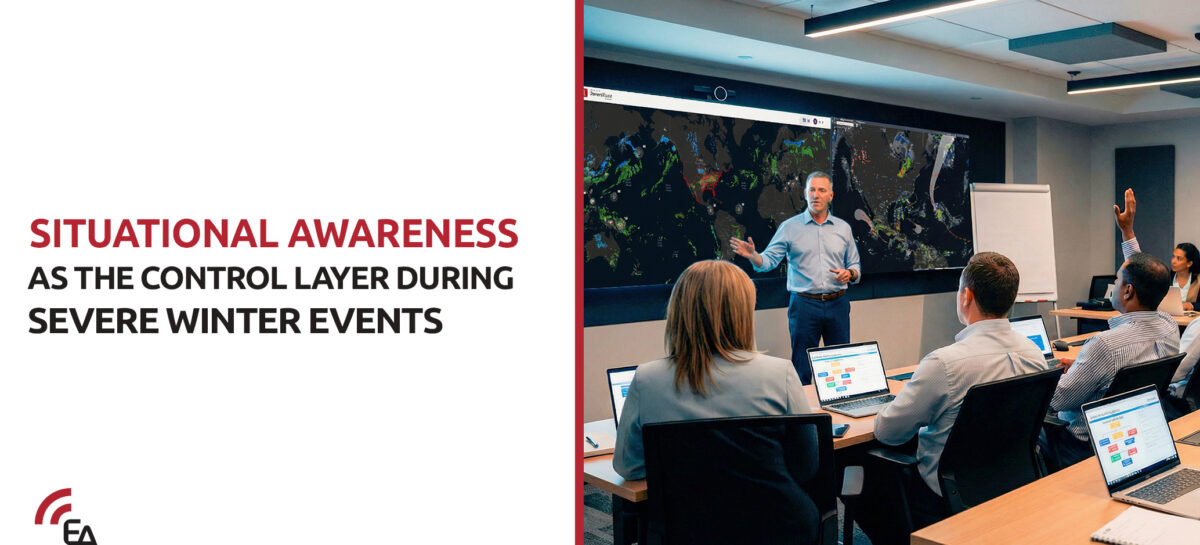
Severe winter events expose enterprise fragility in ways few other disruptions can. They are not confined to a single site or moment in time. Cold, ice, wind, and extended duration place simultaneous pressure on facilities, workforce safety, transportation, and service delivery. What begins as a forecast quickly becomes a test of how well the organization can operate under sustained strain.
For executive teams, the challenge is cumulative. Leaders must protect people, maintain operations, and preserve continuity at the same time, often across multiple regions experiencing different conditions. Decisions made early set the tone for days, not hours. In this context, situational awareness functions as the control layer that stabilizes leadership decision-making as conditions deteriorate. It provides orientation when visibility is uneven and helps executives govern through prolonged uncertainty with discipline rather than reaction.
Why Winter Disruption Escalates Faster Than Most Leaders Expect
Winter disruption rarely announces itself as a crisis. Early signals often feel manageable. A facility delays here, a staffing concern there. Yet winter risk compounds quickly as conditions persist and impacts intersect. What appears localized can expand across the enterprise before alignment fully forms.
Workforce availability declines as travel becomes unsafe. Facilities face access issues, power strain, or deferred maintenance. Transportation slows, affecting supply chains and customer commitments. Service expectations rise as stakeholders seek clarity while conditions worsen. Each element on its own may be manageable. Together, they create escalation that moves faster than coordination.
This dynamic explains why alignment often lags behind impact during winter events. Leaders are not reacting to a single disruption, but to a cascade that builds over time. Winter risk is not sudden. It is cumulative and compounding, demanding early structure to prevent manageable issues from becoming enterprise-wide challenges.
The Decision Challenge During Severe Winter Conditions
Severe winter conditions compress decision-making in ways that strain traditional response models. Executives receive competing updates from weather data, operational teams, and regional leaders, each reflecting a different slice of reality. Forecasts evolve. Conditions shift unevenly across the footprint. Time horizons extend, forcing leaders to make decisions that must hold over days rather than hours.
Incomplete visibility becomes the central challenge. Leaders must determine when to escalate, when to adjust operations, and when to hold steady, often without a unified picture of exposure. Delayed or inconsistent decisions carry real costs. Workforce guidance becomes fragmented. Operational adjustments lose coherence. Recovery timelines stretch because early actions lacked alignment.
In these conditions, leadership does not need more alerts. It needs clarity before certainty. Situational awareness serves as a decision enabler, helping executives understand what matters now, what can wait, and what actions preserve control as winter conditions evolve.
All-Hazard Situational Awareness as the Control Layer
Winter events cannot be managed as weather-only problems. Cold-weather disruption intersects with safety, operations, facilities, IT, and continuity in ways that defy siloed response. A power issue affects systems. Access challenges affect staffing. Communication strain affects trust. Managing these intersections requires a unified perspective.
All-hazard situational awareness provides that control layer by integrating diverse inputs into an enterprise view that holds across conditions. Instead of reacting to isolated signals, leaders gain a coherent understanding of exposure and priority. This perspective supports earlier prioritization, reduces internal contradictions, and accelerates alignment across functions.
For executives, the value is tangible. Decisions move faster because they are grounded in shared understanding. Teams act with consistency because direction is clear. Leadership retains control not by micromanaging details, but by governing through structured awareness that adapts as winter conditions change.
Turning Winter Signals into Actionable Insight
Forecasts and alerts are essential, but they are not sufficient. Raw data describes conditions, not consequences. During winter events, leaders must translate signals into insight that informs action across the enterprise.
That translation begins with relevance. Which regions, facilities, or operations are affected? Severity and duration shape how quickly decisions must be made and how long they must hold. Operational exposure clarifies what is at risk, from workforce safety to service continuity. Timing determines whether actions preserve flexibility or force costly reversals.
Escalation discipline is as critical as detection. Without clear thresholds, organizations either escalate too early, creating fatigue, or too late, losing control. This is where expert-led risk intelligence becomes decisive. By applying judgment and context to winter data, experts help leadership move from awareness to action with confidence. Signals become sense-making, and sense-making becomes decisions that stabilize the enterprise through prolonged winter disruption.
Where Situational Awareness Changes Outcomes During Winter Events
The value of situational awareness becomes most visible when winter conditions stretch across days, regions, and operational boundaries. In these moments, early clarity often determines whether disruption remains manageable or escalates into sustained instability.
Workforce safety and attendance across regions
What breaks down first is consistency. Regional leaders interpret conditions differently, and guidance to employees becomes uneven. Situational awareness reshapes the decision posture by aligning leadership on where risks are most acute and how conditions are evolving. Executives gain clarity on when to adjust staffing expectations, implement safety measures, or modify operations, allowing decisions to move quickly without contradiction.
Facility access, closures, and critical infrastructure strain
Facilities experience uneven impacts from ice, power strain, or access restrictions. Without a unified view, leaders react site by site. With structured awareness, decision-making shifts from reactive closure to prioritized protection. Leaders gain control over which sites require immediate action and which can continue operating with mitigation in place.
Transportation and supply chain disruption
Transportation slowdowns rarely affect all routes equally. Fragmented visibility leads to delayed adjustments and missed opportunities to reroute or stage resources. Situational awareness provides an enterprise-wide picture of movement constraints, enabling leaders to prioritize critical deliveries and protect customer commitments with greater confidence.
Prolonged weather impacting recovery and resumption timelines
Extended winter conditions test recovery discipline. Without clarity, recovery actions drift, and resumption timelines stretch. When awareness is maintained across phases, leaders retain pace and control, ensuring recovery decisions remain aligned as conditions gradually improve. In these scenarios, all-hazard situational awareness becomes the stabilizing force that keeps execution coordinated throughout the event lifecycle.
Why Expertise Matters When Winter Conditions Remain Fluid
Prolonged winter events expose the limits of purely automated systems. Dashboards struggle when conditions evolve unevenly across regions and forecasts shift repeatedly. Data volume increases, but clarity does not.
Expert support changes this dynamic. Specialists bring judgment under uncertainty, helping leadership interpret incomplete or conflicting signals without waiting for perfect confirmation. Contextual framing connects regional impacts to enterprise priorities, ensuring decisions reflect both local realities and overall exposure. Scenario-based guidance helps leaders anticipate how conditions may unfold over time, rather than reacting to each update in isolation. Leadership-ready briefings translate complexity into direction that executives can act on.
This approach reduces decision fatigue. Confidence increases because leaders are not forced to reconcile fragmented inputs on their own. With expert-led risk intelligence, situational awareness remains steady even as conditions shift, supporting sustained control during long-duration winter events.
What Leaders Should Demand from Winter Situational Awareness Capabilities
Executives evaluating winter readiness should focus on performance under prolonged stress, not feature lists. A leadership-grade situational awareness capability must support decisions that hold over time and across regions.
Key criteria include:
- Enterprise-wide visibility that spans regions, sites, and operating units
- Relevance over volume, prioritizing what affects decisions rather than flooding leaders with data
- Integration of expertise and technology so interpretation keeps pace with detection
- Clear escalation thresholds that define when leadership engagement is required
- Executive reporting that supports continuity, recovery, and resumption decisions
- Alignment with emergency and continuity operations to maintain consistency across phases
When these elements are present, situational awareness functions as an operating capability rather than a monitoring layer. It strengthens leadership confidence during winter events and supports disciplined execution as conditions evolve.
Control Is the Outcome That Matters Most in Winter Events
Severe winter events are inevitable. They will continue to test enterprises through duration, uncertainty, and overlapping impacts. What leaders can control is how well the organization maintains clarity and coordination as conditions deteriorate and recover.
Loss of control is not a requirement of winter disruption. With situational awareness designed as a leadership system, executives can preserve stability, protect safety, and sustain performance even as conditions remain fluid. Early clarity shapes outcomes long before the worst impacts arrive.


