



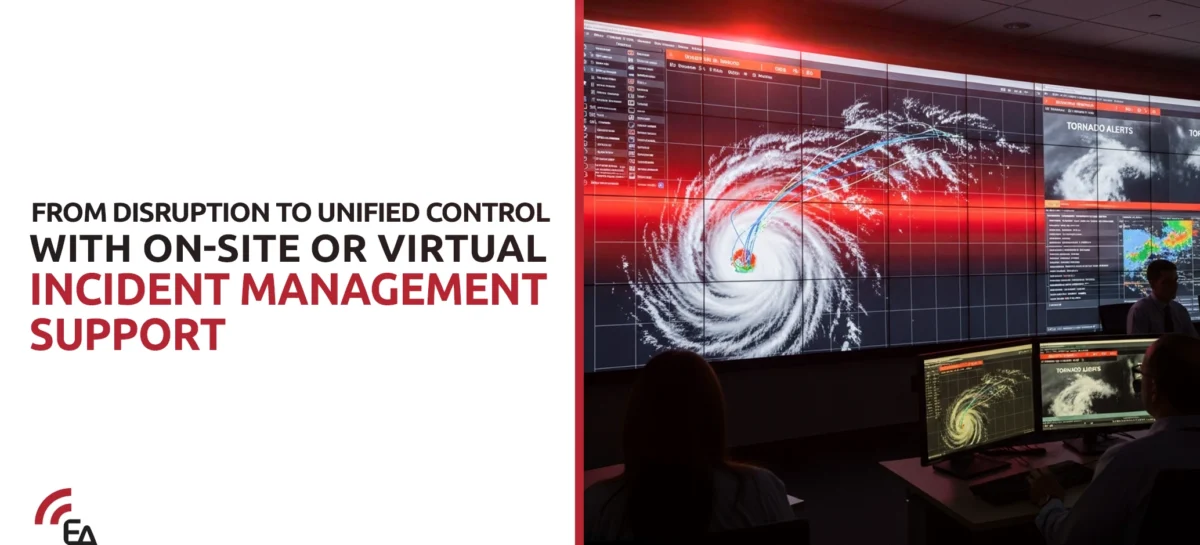
The first hour of disruption is where leadership credibility is tested in real time. Teams look for direction, operations look for priorities, and stakeholders expect clarity even when the situation is still forming. In that window, time compresses quickly. What begins as a localized issue can expand across sites, vendors, customers, or workforce availability before the organization has fully aligned on what is happening.
Executives often face a familiar challenge: competing updates arrive from multiple directions, ownership feels distributed, and escalation moves unevenly. Operational leaders may be acting fast at the ground level while enterprise leadership is still assembling a unified understanding. When decisions slow, exposure increases. Response becomes inconsistent across business units. Messaging loses precision, and the organization spends energy reconciling internal contradictions instead of executing the next right action.
Unified control is the outcome leaders seek, not in a theoretical sense, but in operational reality. It is the ability to establish clarity, pace, and coordination fast enough to prevent disruption from becoming an enterprise-wide continuity event.
Why Even Strong Organizations Lose Coordination Under Pressure
Most organizations do not fail because they lack plans. Many have continuity programs, crisis response documentation, and experienced teams. The breakdown happens when incidents move from readiness on paper to execution across a distributed enterprise. Activation varies by site, responsibilities shift quickly, and decision-making becomes harder under uncertainty.
As disruptions unfold, the response environment naturally fragments. Operations teams move fast locally to stabilize impact. Executive leadership seeks enterprise-wide clarity to protect business performance and maintain confidence. Security, communications, and continuity leaders fight for bandwidth because every function has urgent responsibilities that must happen at the same time. The result is predictable: meetings multiply, decisions slow, and updates begin to conflict.
What makes this especially difficult is timing. Coordination becomes the heaviest requirement during disruption, at the exact moment capacity drops. Leaders are managing incomplete information, limited attention, and growing stakeholder pressure. Even high-performing teams can lose rhythm when incident structure is missing, and escalation pathways are unclear.
The Operating Standard Leaders Expect During Incident Conditions
Unified control is not a slogan. It is an operating standard that enables an enterprise to respond with discipline when conditions shift quickly. Leaders do not need activity for its own sake. They need a response environment that supports faster decisions, cleaner execution, and consistent communication across teams that may be distributed, stressed, and operating with partial context.
In practical terms, unified control delivers:
- Clarity of command and escalation: leadership knows who owns decisions, who executes actions, and how responsibilities flow
- Consistent messaging and decision cadence: internal updates remain aligned, purposeful, and timely
- Real-time situational alignment: teams operate from the same understanding of status, impact, and priorities
- Faster operational execution: decisions translate into action without repeated rework or duplicate efforts
- Accountability that holds under stress: actions, owners, and outcomes remain visible and trackable
When unified control is present, leadership can focus on continuity outcomes while operational teams execute with confidence. The organization moves with pace and precision, without losing governance.
The Role of Incident Management Support
Incident management support exists for a simple reason: disruption forces leaders to manage response structure and business continuity at the same time. Even experienced internal teams can become overloaded when incidents expand across multiple sites or create simultaneous operational pressures. Support becomes most valuable when it brings structure quickly, reinforces coordination, and keeps execution aligned to leadership intent.
This is where all-hazard emergency management capability matters. A support model built for varied disruption types allows organizations to respond with discipline, whether the triggering event is weather-related, operational, human-caused, or technology-driven. The focus stays consistent: stabilize, coordinate, and maintain operational continuity.
On-site incident management support becomes critical when leadership needs physical coordination, command reinforcement, and rapid alignment across local teams. Virtual support becomes equally powerful when speed is essential, travel is limited, operations are distributed, or a centralized leadership rhythm must be established across multiple locations. In both cases, what determines success is not the format. It is the ability to deliver structure fast enough to regain control before disruption escalates.
How Incident Management Support Stabilizes Decision-Making and Execution
When an incident is active, executives face two simultaneous responsibilities: stabilizing operations and maintaining enterprise confidence. Incident management support is strengthened by bringing structure to the response environment before uncertainty spreads. The impact is immediate. Decision-making becomes more deliberate. Communication becomes more consistent. Teams regain momentum because responsibilities and escalation pathways are clarified early, rather than debated in the middle of execution.
Strong support introduces a decision rhythm that leadership can rely on. Updates stop arriving as disconnected fragments and begin arriving as disciplined reporting that reflects operational priorities. That rhythm reduces fatigue across the executive team and gives business leaders a clearer basis for determining what must happen now, what should be staged next, and what requires monitoring.
Effective incident management support typically reinforces three outcomes that C-suite leaders care about most:
- Executive briefings and decision checkpoints: A reliable cadence that helps leadership align quickly and sustain direction as conditions evolve
- Incident action structure and task ownership: Clear responsibility across teams, reducing duplication and protecting response speed
- Communication discipline and stakeholder coordination: Consistent internal messaging and coordination across operations, security, continuity, and leadership
As response structure strengthens, situational awareness becomes actionable. Decision thresholds become clearer. The organization moves forward with control through the disruption lifecycle, supporting Respond, Manage, and Recover without losing coherence.
What SMEs Add That Technology Cannot
Technology has transformed how organizations detect events, monitor impacts, and distribute updates. Yet even the best systems cannot replace the judgment required when uncertainty is high and time is limited. Leaders often find themselves staring at dashboards that describe what is happening without clarifying what it means for continuity, operations, and immediate leadership decisions.
SMEs bridge that gap by turning information into interpretation and interpretation into decision direction. The value is not theoretical. It becomes visible in faster alignment, fewer contradictions, and a calmer response environment that stays disciplined even under pressure. SME-driven emergency management gives executives confidence because it supports decisions with informed context rather than assumptions.
SMEs strengthen incident execution through:
- Incident leadership support that reinforces command structure and decision cadence
- Contextual risk framing tied to enterprise exposure, not generic event categories
- Decision guidance that helps leadership separate urgent action from avoidable reaction
- Response structure reinforcement that keeps teams aligned across evolving conditions
In boardroom terms, expertise reduces decision drag. It also protects leadership credibility by ensuring the response posture remains structured and consistent as the situation unfolds.
Where Enterprises Gain the Most Value
Incident management support delivers the greatest impact when complexity rises, variables change quickly, and multiple business units feel pressure at once. In these environments, unified control creates separation between an incident that stays contained and one that escalates into broader disruption. The value becomes even more pronounced when organizations must coordinate across sites, stakeholders, and operating systems while maintaining continuity.
Below are four high-stakes scenarios where all-hazard readiness and rapid coordination matter most.
Severe Weather Threats to Facilities and Workforce
Weather events place pressure on people’s safety, facility access, and staffing continuity. What breaks down first is often consistency, as sites respond based on local interpretation while leadership needs an enterprise view. On-site support strengthens physical coordination and readiness posture, while virtual support can establish leadership cadence across regions. With all-hazard emergency management, executives gain earlier alignment on protective actions, staffing posture, and operational adjustments before conditions deteriorate.
Cyber Disruption Impacting Operations
Cyber incidents accelerate decision pressure because operational risk can spread faster than confirmation. Leaders must balance containment, continuity, and communication discipline without relying on incomplete technical narratives. Virtual incident management support is especially valuable here, enabling structured executive briefings and coordinated response across IT, security, operations, and leadership. Unified control reduces contradictory updates and keeps decisions anchored to operational priorities.
Facility Incidents Affecting Safety and Service Continuity
Facility incidents can disrupt workforce safety, site operations, and customer delivery timelines within minutes. Local teams often act immediately, while enterprise leadership needs clarity on scale, escalation, and resource needs. On-site incident support brings direct coordination and stabilization, while virtual support ensures enterprise alignment and consistent communication. Unified control helps leaders protect safety, sustain continuity, and coordinate recovery with fewer delays.
Regional Events Affecting Mobility, Supply Chain, or Multi-Site Operations
Regional disruption introduces cascading impacts that are difficult to manage without structure. Mobility constraints, supplier issues, and multi-site interruptions often appear in different parts of the organization simultaneously. Virtual incident support becomes essential for establishing a centralized decision rhythm while enabling coordinated actions across business units. Unified control helps leadership maintain visibility, prioritize actions, and protect operational performance across the footprint.
How to Evaluate Incident Management Support
Executives do not evaluate incident management support based on how it sounds in a proposal. They evaluate it based on whether it will perform under real conditions, across real incidents, with real consequences. Leadership needs support that strengthens decision posture, accelerates alignment, and improves continuity execution without creating additional complexity.
When evaluating incident management support, executive teams should demand:
- Capability across incident types: Support must hold up across diverse scenarios, not only a narrow set of events
- Readiness to deploy on-site or virtually with speed: Response structure must arrive quickly, not after the disruption has expanded
- Structured escalation and role clarity: Leaders should never be forced to improvise ownership during critical decision windows
- Leadership-grade communication discipline: Briefings and messaging must stay consistent, controlled, and operationally relevant
- Continuity focuses beyond incident closure: The objective must include stabilization, recovery posture, and resumption readiness
- Integration into broader readiness programs: Support should reinforce continuity maturity over time, not operate as an isolated function
A strong model delivers more than a response. It reinforces governance, accountability, and consistent execution, creating a response environment where leadership can act with confidence.
The Real Goal Is Stability, Not Activity
Incidents will happen. Volatility and uncertainty are part of the modern operating environment. What separates resilient organizations is not whether disruption occurs, but how well they execute when it does. Disorganized response erodes operational performance and leadership credibility. Unified control restores both by reinforcing structure, clarity, and pace when teams need it most.
Incident management support gives leaders the stability required to make time-critical decisions, coordinate enterprise action, and sustain continuity through disruption. It allows executives to govern with confidence rather than chase fragments of information across siloed teams.
Talk to an EarlyAlert expert about incident management support for your enterprise, and explore how on-site or virtual incident support strengthens continuity leadership.


