



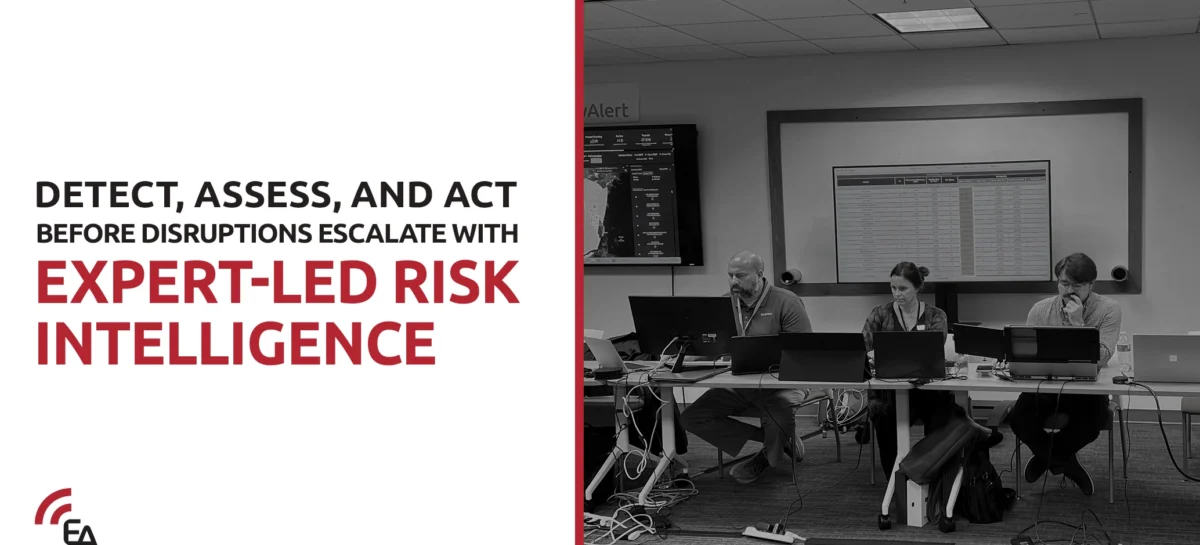
Disruption rarely arrives with a clear headline and a clean set of decisions. It begins quietly, often as an operational anomaly that feels manageable in isolation. A weather pattern shifts. A regional incident changes travel conditions. A cyber event introduces uncertainty into business systems. A workforce disruption appears in a single facility before spreading across sites. Early signals tend to look like background noise until they become expensive.
That ambiguity creates a particular kind of pressure for executive teams. Leaders are balancing competing priorities, fragmented updates, and incomplete context while still being expected to make confident calls. In those moments, the organization does not need more information. It needs clarity, speed, and aligned direction. The real risk emerges when escalation accelerates faster than leadership alignment. By the time teams agree on what is happening, the window to act early is already narrowing.
Where Enterprise Awareness Breaks
Most organizations have invested heavily in monitoring and risk awareness. The gap rarely comes from a lack of tools. The gap comes from what happens when those tools operate independently, generating signals without a unified decision structure. Leaders are then forced to interpret noise across dashboards, inboxes, vendor alerts, and internal channels that were never designed to work together under time pressure.
Tool sprawl creates competing versions of truth. Intelligence might live in one system, internal communication in another, and continuity plans sit in static documents that are difficult to activate quickly. Meanwhile, operational teams are moving in parallel, each responding based on their local view of the situation. The result is a familiar pattern: escalation hesitates, ownership fragments, and decisions stall while teams wait for more certainty.
This breakdown is most visible inside mature organizations, where complexity introduces delay. Even strong teams can respond late or inconsistently when the escalation path is unclear and situational updates arrive in conflicting formats. In executive terms, the organization absorbs risk through decision lag. That lag is rarely dramatic in the moment, but it becomes obvious when disruption expands, and leaders realize the early advantage is gone.
How Executive Teams Stay Ahead of Escalation
The most resilient organizations operate with a disciplined approach to uncertainty. They build continuity maturity by reducing friction in the moments that decide outcomes. A practical framework that supports this discipline is Detect–Assess–Act. It provides structure without slowing the organization down, and it creates the conditions for faster alignment when disruption begins to move.
Detect: Identify emerging signals across the enterprise footprint
Detection becomes valuable when leaders gain earlier visibility into developing risk, without elevating every signal to executive urgency. This is where all-hazard situational awareness matters. It enables leaders to see early indicators across the operating environment and recognize patterns that could affect continuity, workforce safety, or service reliability.
Assess: Translate noise into operational relevance and business exposure
Assessment filters what matters most. It connects external conditions to enterprise reality: which sites are exposed, which operations are impacted, and how quickly the situation is evolving. Executives gain a clearer sense of what requires action now versus what should remain under watch.
Act: Move with speed and control, not motion and confusion
Acting early does not mean overreacting. It means making measured decisions while there is still time to protect operations, coordinate internal teams, and prevent disruption from expanding into a broader continuity event. When action is disciplined, response becomes faster, communication becomes clearer, and the organization preserves options rather than losing them.
Seeing Risk Across the Entire Operating Environment
Enterprise detection becomes meaningful when it reflects the reality of the operating environment. Leaders need visibility across the hazards that can disrupt business continuity, including severe weather, operational disruptions, regional instability, facility impacts, cyber incidents, and evolving conditions that affect workforce mobility. The challenge is not finding information. The challenge is detecting risk early enough and connecting it to what matters operationally.
A leadership-grade detection posture maps risk to the parts of the business that carry the most exposure:
- People: workforce safety, staffing continuity, travel conditions, localized threats
- Facilities: site access, physical disruption risk, operational readiness constraints
- Supply chain: vendor instability, route constraints, and regional disruptions that affect delivery
- Customer operations: service continuity, fulfillment, uptime expectations, reputational sensitivity
When detection is context-aware, executives gain earlier visibility without unnecessary escalation. The organization can shift posture before disruption becomes unavoidable. Teams have time to coordinate, leadership has time to align, and response becomes proactive rather than reactive. This is where early action becomes a competitive advantage, built on disciplined detection rather than sudden reaction.
Turning Signals into Decision-Grade Intelligence
Detection creates visibility, but assessment creates confidence. At the executive level, confidence is earned through disciplined filtering, not through volume. Leaders need a clear interpretation of what matters, what can wait, and what requires immediate movement. That requires assessment designed for operational decision-making, not surface-level awareness.
Effective assessment evaluates risk through an executive lens:
- Relevance: Does this event intersect with our footprint, operations, or workforce?
- Severity: If conditions worsen, what is the scale of exposure?
- Timeframe: How quickly could this become disruptive, and where is the decision window?
- Operational impact: What downstream effects could follow across the supply chain, customer service, or facilities?
High-quality assessment also answers the questions that matter most in a leadership briefing. What is happening right now? How does it affect operations within the next 2, 6, or 24 hours? What decision is required immediately, and what should remain under monitoring while teams prepare? Clarity at this stage prevents overreaction, but it also prevents costly delay. The strongest outcomes come from disciplined escalation thresholds and visible accountability, supported by critical decision support from SMEs when uncertainty is high and time is limited.
Making Early Moves That Protect Operations
When disruptions start to take shape, the best leadership decisions are often the ones made early, while options still exist. Acting early does not mean accelerating into noise. It means making controlled operational moves that reduce exposure, protect continuity, and prepare teams before conditions tighten. Executives rarely regret disciplined preparation. They often regret waiting until action becomes urgent.
Operationally, early action depends on alignment. Security, operations, continuity leadership, and executive teams need to move as one, with clarity on roles and authority. When this alignment is established, leaders can make measured decisions that create stability across the organization.
Examples of early moves that protect operations include:
- Mobilizing response posture with defined escalation paths and leadership briefings
- Issuing structured internal guidance so teams operate with consistent expectations
- Adjusting operational plans for facilities, travel, staffing, and vendor readiness
- Protecting the workforce and critical assets through practical readiness measures and clear communication
This is where governance matters. The goal is not speed alone. The goal is speed with control, backed by accountability and a shared operational picture that leaders can trust.
Why Expertise Changes the Outcome
Technology plays a vital role in modern risk detection, but executive decisions rarely hinge on detection alone. Leaders make decisions based on interpretation, context, and consequence. The difference between a disruptive event that stays contained and one that escalates often comes down to how quickly teams can translate signals into executive-grade understanding.
This is where subject matter experts create a measurable advantage. SMEs bring more than experience. They bring decision framing that reduces uncertainty and strengthens leadership alignment in moments when operational stakes are high.
Expert support provides:
- Judgment under uncertainty when signals are incomplete or evolving
- Contextual risk framing tied to enterprise operations, locations, and exposure
- Scenario-based guidance that clarifies what to do now versus what to stage
- Leadership-grade briefings that support faster alignment and fewer internal contradictions
In real conditions, this capability improves the quality and pace of decisions while reducing the fragmentation that often slows response. When disruption moves quickly, critical decision support from SMEs helps leadership maintain control, act with confidence, and sustain continuity across the organization.
Resilience Is Built Before the Headline Hits
Resilient organizations rarely succeed because they predict perfectly. They succeed because they operate with discipline when uncertainty arrives. They detect early signals, assess with clarity, and act with control while time is still on their side. That rhythm strengthens continuity outcomes and gives leadership the confidence to guide teams through disruption without unnecessary friction.
Detect–Assess–Act is not a theoretical model. It is a leadership posture. When it is supported by expert-led risk intelligence and all-hazard situational awareness, organizations gain earlier visibility, stronger alignment, and better continuity performance under pressure.
Talk to an EarlyAlert expert about your situational awareness posture, and explore expert-led intelligence built for continuity leadership.


