



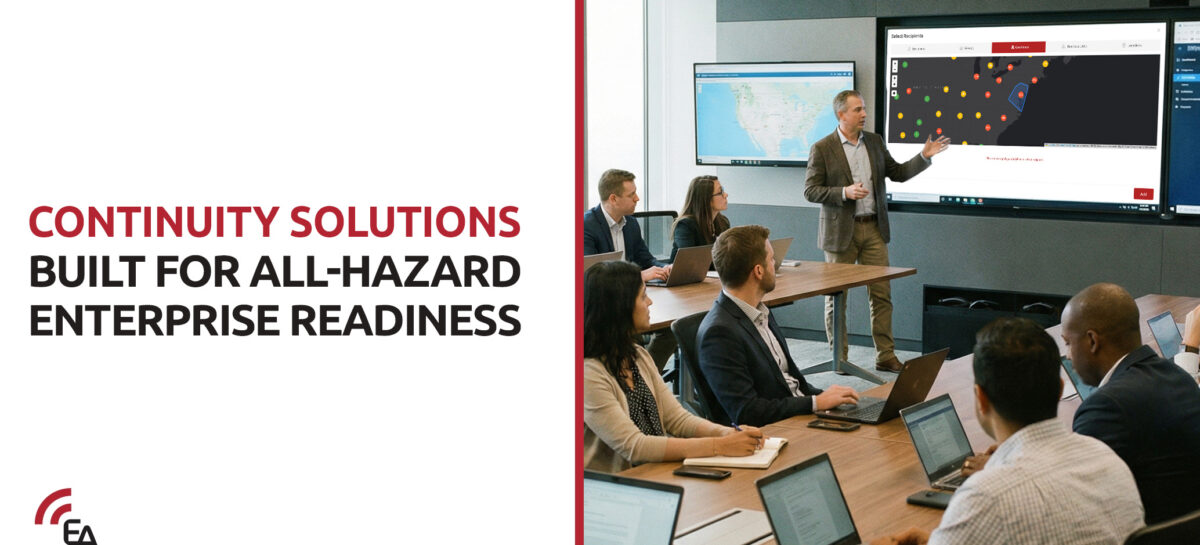
Disruption is no longer a rare interruption that leaders can plan around with confidence. It is a continuous operating condition shaped by overlapping risks that move faster than traditional response cycles. Weather volatility, cyber incidents, workforce instability, supplier disruptions, and regional events increasingly occur in combination, not isolation. For enterprises operating at scale, these conditions compress decision windows and expose gaps that were once hidden during calmer periods.
The executive challenge is not simply managing risk. It is sustaining performance while exposure remains persistent. Leaders are expected to protect operations, maintain customer confidence, and preserve organizational momentum even when clarity is incomplete. In this environment, continuity cannot be treated as a recovery mechanism that activates after impact. It must function as a leadership discipline that supports execution before, during, and after disruption. Readiness becomes the means by which enterprises protect momentum, not just restore it.
Why Traditional Continuity Programs Fail Under Real Conditions
Most organizations are not starting from zero. They have continuity plans, documented procedures, and compliance-driven programs that look sound on paper. The breakdown happens when those plans meet real conditions. Activation becomes harder than expected. Decision pathways are unclear. Teams revert to local habits because enterprise-level coordination feels slow or uncertain.
Readiness also weakens when it is uneven across the organization. One region may be well trained, while another relies on outdated assumptions. Exercises are often periodic and compliance-focused, but they lose relevance as priorities shift. When disruption occurs, response becomes coordination-heavy and decision-light. Meetings multiply, ownership blurs, and recovery stalls because escalation thresholds were never truly operationalized.
This pattern reflects an execution gap, not a planning failure. Traditional programs emphasize documentation and audit readiness, while real conditions demand speed, alignment, and clarity. Without an operating model designed for pressure, continuity struggles to perform when leaders need it most.
What All-Hazard Readiness Actually Means at Enterprise Scale
All-hazard readiness is often misunderstood as preparing for every possible scenario in detail. At enterprise scale, that approach quickly becomes unmanageable. Modern hazards intersect and cascade, creating conditions that defy rigid categorization. A severe weather event can trigger facility closures, workforce constraints, supply chain delays, and communication challenges within hours. A cyber disruption can evolve into an operational continuity issue that affects customers and leadership credibility.
The goal of all-hazard readiness is not exhaustive documentation. It is a unified operating posture that holds across disruption types. Instead of separate playbooks for each risk, leaders need a consistent framework for assessing impact, escalating decisions, and coordinating action regardless of the trigger. This approach allows teams to adapt to conditions while maintaining alignment and control.
For executives, the takeaway is clear. Consistency of execution matters more than the specificity of documentation. When readiness is built to scale across hazards, enterprises move faster and with greater confidence as conditions evolve.
Continuity Solutions That Perform When Disruption Becomes Operational
Documentation alone rarely performs under pressure. Plans can outline intent, but they do not automatically translate into action when decisions must be made quickly and across multiple functions. When disruption becomes operational, leaders need continuity capabilities that support execution, not just reference material.
Effective continuity must deliver four outcomes during active conditions:
- Decision clarity that helps leaders understand what matters most and what must happen next
- Operational alignment that keeps teams moving in the same direction across sites and functions
- Recovery coordination that stabilizes operations without introducing new friction
- Resumption speed that restores momentum before disruption costs compound
This is where enterprise continuity solutions create measurable value. They bridge preparedness intent with operational execution, providing a structure that holds under pressure. By connecting readiness to real-time decision-making and coordinated action, continuity becomes a performance enabler rather than a static requirement. In doing so, it strengthens both business continuity and resilience when conditions demand disciplined leadership.
How Preparedness Protects Performance
Disruption becomes most expensive after the initial impact. The longer operations remain unstable, the more costs accumulate across productivity, customer confidence, workforce strain, and leadership credibility. Resumption is where these pressures either compound or begin to stabilize. For CEOs and COOs, the speed and control with which the organization regains footing is a direct measure of preparedness and maturity.
Preparedness accelerates stabilization by removing friction before disruption occurs. Decision ambiguity is reduced when roles, escalation paths, and priorities are already aligned. Responsibilities are pre-positioned, allowing teams to move without negotiating ownership mid-incident. Response drift and rework decline because actions are coordinated through a shared operating posture rather than improvised locally.
This discipline supports speed with control. Leaders can authorize recovery actions confidently, knowing they are aligned with enterprise priorities and continuity objectives. In this context, business continuity and resilience are not abstract ideals. They are performance protectors that shorten recovery timelines and preserve momentum when disruption threatens to slow the organization down.
Where Enterprises Gain the Most Value from Continuity Readiness
Continuity readiness shows its value when complexity increases, and conditions evolve faster than teams can adapt on the fly. Across industries, the same patterns emerge, regardless of the triggering event.
Severe weather impacting facilities and workforce availability
What breaks down first is consistency. Sites interpret conditions differently, and leadership struggles to understand exposure across regions. Structured continuity readiness aligns assessments and actions, giving leaders clarity on workforce safety, facility access, and operational adjustments. Pace improves because decisions are made once and executed consistently.
Cyber disruption affecting operational continuity
Technical response often moves quickly, while business alignment lags. Continuity readiness reframes the issue around service impact, customer commitments, and recovery sequencing. Leaders gain control by coordinating technology, operations, and communications through a unified response posture.
Facility incidents impacting safety and service delivery
Local action is immediate, but enterprise coordination can be delayed. Continuity readiness clarifies ownership and escalation early, allowing leaders to protect safety while sustaining service continuity. Execution becomes deliberate rather than reactive.
Supply chain or regional disruptions affecting multi-site operations
Fragmentation appears as different functions assess risk independently. Continuity readiness connects these assessments, enabling leaders to prioritize actions, allocate resources, and maintain operational performance across the footprint.
How Leaders Should Evaluate Continuity Readiness at Scale
Continuity programs often look complete until they are tested. Executives should evaluate readiness based on how it performs under pressure, not how comprehensive the documentation appears. A leadership-grade posture supports execution across the enterprise and strengthens confidence during disruption.
Key evaluation criteria include:
- Consistent activation across sites and regions, ensuring response does not vary by location
- Readiness that is measurable and maintained, rather than reviewed only during audits
- Response and recovery tested through realistic scenarios, not theoretical exercises
- Resumption built into planning, treated as a priority rather than an afterthought
- Executive visibility into readiness posture and gaps, supporting informed oversight
- Alignment across operations, IT and security, continuity, and leadership, reducing friction during execution
When these elements are present, enterprise continuity solutions become a reliable operating capability that leaders can trust at scale.
Readiness Is the Quiet Work That Protects Enterprise Momentum
Continuity rarely draws attention when it works well. Its value becomes visible only when disruption tests the organization’s ability to execute under pressure. Leaders who invest in readiness as a discipline gain stability when conditions become volatile, allowing teams to act with confidence rather than improvise.
The strongest organizations do not rely on binders or periodic reviews. They build readiness that performs, reinforcing clarity, coordination, and control when it matters most. Mature continuity protects more than operations. It safeguards credibility, performance, and trust across stakeholders who expect consistency even during disruption.
Explore continuity solutions designed for all-hazard enterprise readiness.


