



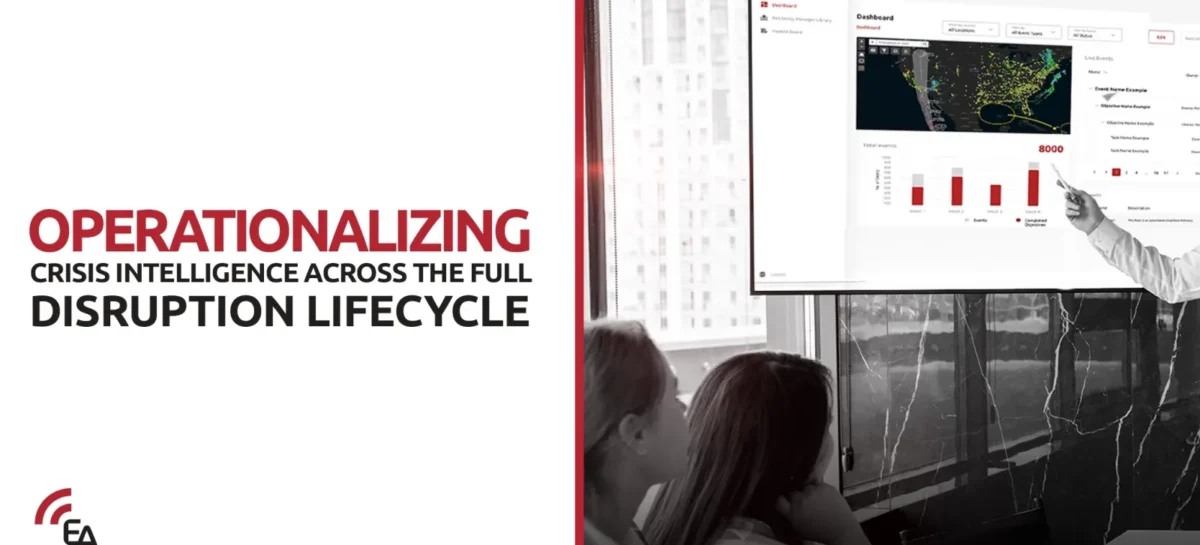
Enterprise leaders are not short on information. Cyber threat feeds update by the minute. Weather systems are tracked in real time. Geopolitical developments surface instantly across global channels. Operational alerts pulse through internal systems every day. The challenge is rarely access to data. The challenge is translating intelligence into structured enterprise action.
Crisis frequency is rising across domains. Severe weather disrupts logistics corridors. Ransomware halts production lines. Political instability affects supply chains overnight. Each event generates signals. Few organizations convert those signals into disciplined execution across business units.
Fragmented systems compound the issue. Security teams operate in one environment. Facilities teams rely on each other. Communications functions work independently. Leadership receives updates in fragments, often without operational context. Decision velocity slows as teams reconcile inconsistent inputs.
Boards now expect documented oversight. They ask how risks were assessed, what thresholds triggered a response, and how recovery performance was measured. Intelligence alone does not satisfy these expectations. Resilience requires operationalization.
A crisis management platform becomes strategically valuable only when it connects detection, response, recovery, and reporting into one structured lifecycle. In this model, crisis intelligence shifts from an IT utility to a governance asset. It informs executive judgment, reinforces accountability, and strengthens enterprise stability under pressure.
The Full Disruption Lifecycle: Where Most Enterprises Break Down
Disruption unfolds across phases. Organizations prepare through planning and training. They detect emerging risks. They respond to immediate impact. They manage ongoing disruption. They recover critical functions. They resume normal operations. They monitor residual effects and lessons learned.
The friction often appears between these phases.
Plans may exist in static documents stored across departments. During a live incident, teams scramble to interpret outdated files. Detection systems generate alerts, yet response workflows remain manual. Communications platforms operate separately from incident tracking tools. Recovery milestones are tracked informally through spreadsheets or email threads. After-action documentation becomes an afterthought once operations stabilize.
This fragmentation creates measurable consequences:
- Delays in activating continuity plans
- Siloed decision-making across departments
- Inconsistent executive reporting
- Escalating financial exposure as response windows narrow
When lifecycle phases operate independently, leadership loses visibility across the broader disruption arc. Decisions in early stages fail to align with recovery objectives. Lessons learned fail to inform preparedness updates.
EarlyAlert’s SmartSuite — a unified platform for preparedness and recovery provides structural continuity across these stages. By integrating planning artifacts, live intelligence, operational tasks, and performance tracking, enterprises move from reactive patchwork to lifecycle discipline. The result is greater coherence from the first alert to the final review.
From Monitoring to Operational Alignment: Turning Intelligence into Action
Real-time monitoring is only the starting point. Operational strength emerges when monitoring integrates directly into enterprise workflows.
A modern crisis management platform connects live threat data to predefined continuity thresholds. When risk indicators meet escalation criteria, structured actions are initiated automatically. Leadership teams gain shared visibility into evolving conditions and active response measures. Tasks are assigned within the same environment that houses threat intelligence. Progress updates reflect in real time.
Several capabilities accelerate execution:
- Monitoring feeds linked to business impact parameters
- Escalation triggers aligned with continuity playbooks
- Enterprise-wide visibility across sites and departments
- Centralized task tracking tied to recovery objectives
- Executive dashboards summarizing status and exposure
This integration reduces ambiguity. Leadership no longer debates which dataset is current or which team-initiated action. Decisions occur within a common operating context. Time-to-decision shortens as inputs align and responsibilities are clear.
Operational discipline strengthens when detection, execution, and reporting exist within one ecosystem. The platform becomes an engine for structured alignment rather than a repository for alerts. In high-pressure environments, that distinction defines whether disruption is contained efficiently or prolonged unnecessarily.
Why Expert Interpretation Defines the Difference Between Noise and Foresight
Enterprise environments generate extraordinary volumes of alerts. Security anomalies, weather advisories, infrastructure notifications, and regulatory updates. Without contextual analysis, these signals can overwhelm leadership teams and dilute focus.
Alert fatigue is a genuine risk. Conflicting data streams may point in different directions. Automated systems flag thresholds without evaluating operational nuance. Leaders must determine which signals require escalation and which merit continued observation.
An expert-led crisis management system embeds subject-matter expertise directly into intelligence workflows. Specialists interpret threat indicators within an operational context. They evaluate historical patterns, regulatory implications, and infrastructure vulnerabilities before action thresholds are triggered.
This interpretive layer accomplishes several objectives:
- Filters transient anomalies from material risk developments
- Aligns intelligence with national and international standards
- Translates technical indicators into executive-level implications
- Reinforces governance-grade decision support
When expertise is embedded rather than external, insight flows seamlessly into operational planning. Leadership receives refined analysis instead of raw data. This distinction enhances confidence and reduces the likelihood of overreaction or missed escalation.
Technology amplifies detection speed. Expertise ensures relevance and judgment. Enterprises that combine both cultivate foresight rather than reactive turbulence.
Governance, Compliance, and Audit Visibility Across the Lifecycle
Crisis management now sits firmly within enterprise risk governance. Regulatory scrutiny has intensified. Shareholders evaluate resilience posture. Boards demand structured evidence of preparedness and response maturity.
Framework alignment plays a central role. ISO 22301 establishes business continuity management standards. NFPA 1660 defines all-hazards preparedness structures. FEMA and NIMS models inform public and critical infrastructure environments. Executives must demonstrate that their approach reflects these benchmarks.
Structured documentation becomes essential. Leadership should be able to present:
- Traceable decision logs tied to escalation thresholds
- Documented activation of continuity procedures
- Time-stamped recovery milestones
- After-action analyses integrated into preparedness updates
A mature crisis management platform supports this accountability through integrated audit trails and lifecycle reporting. Executive dashboards summarize performance indicators. Incident records capture actions taken and the rationale applied. Recovery metrics reveal improvement areas.
Such visibility signals sophistication. It shows that crisis intelligence informs enterprise governance rather than operating at the margins of facilities management. When resilience is measurable, traceable, and aligned with recognized standards, leadership confidence strengthens across stakeholders.
Operationalizing crisis intelligence across the full disruption lifecycle, therefore, becomes both a strategic and fiduciary responsibility. Enterprises that treat it accordingly position themselves for sustained stability in an increasingly volatile risk environment.
Eliminating Silos: Unifying Communication, Operations, and Continuity
One of the most persistent executive frustrations during disruption is fragmentation. Communication systems operate independently from incident tracking. Facilities teams assess infrastructure exposure without direct visibility into cyber or operational risk signals. Legal and corporate communications functions often engage only after events escalate publicly. Regional offices act with partial information, creating uneven response patterns across the enterprise.
These silos slow decision-making and dilute accountability. When data, tasks, and messaging exist in separate environments, leadership must reconcile multiple narratives before acting. Valuable time is lost to alignment rather than mitigation.
Enterprise coherence requires structural integration. A unified platform for preparedness and recovery connects situational awareness feeds, incident workflows, mass communication capabilities, continuity plans, and recovery tracking within one operational framework. SmartSuite is designed with this architectural intent, enabling leadership to view evolving threats, active response measures, and recovery progress without toggling across disconnected tools.
In this model, communications reflect verified intelligence. Operations align with continuity thresholds. Executive reporting draws from the same data source that guides field-level action. The organization moves with clarity because its systems move together.
Silos rarely disappear through policy alone. They dissolve when infrastructure reinforces shared visibility and disciplined execution across the full disruption lifecycle.
The Financial Case: Decision Velocity as a Resilience Metric
Resilience carries financial implications that extend beyond immediate repair costs. Delayed shutdowns expose facilities to avoidable damage. Misaligned supply chain decisions lead to inventory shortages or surplus accumulation. Regulatory scrutiny intensifies when escalation pathways appear inconsistent. Public missteps influence brand perception and market confidence.
The cumulative impact often stems from hesitation. When intelligence lacks structure, leadership debates rather than acts. Each hour of uncertainty compounds operational exposure.
Time-to-decision, therefore, becomes a measurable resilience indicator. Enterprises that accelerate structured action protect revenue continuity and stakeholder trust. A mature crisis management platform strengthens this velocity by linking detection to predefined operational thresholds. Cross-functional teams gain shared visibility into risk signals and response status. Escalation processes activate within an integrated environment rather than through fragmented channels.
SmartSuite supports this alignment by centralizing threat intelligence, task assignment, and executive dashboards. The result is disciplined mitigation before peak disruption occurs. Reduced downtime and coherent communication translate into financial steadiness, even amid volatile conditions.
For shareholders and boards, resilience is reflected not in the absence of disruption but in the stability of response. Decision velocity becomes a proxy for operational maturity.
Scaling Across Complexity: Multi-Site, Multi-Hazard, Multi-Region
Large enterprises rarely confront isolated risks. A cyber incident may coincide with severe weather. Political unrest may affect one region while supply chain disruptions ripple across another. Global footprints introduce diverse regulatory environments and infrastructure vulnerabilities.
Scaling resilience across this complexity requires architectural maturity. Localized tools cannot provide enterprise-wide oversight. Regional autonomy without central visibility increases inconsistency and governance exposure.
An expert-led crisis management system scales by embedding standardized workflows while preserving regional flexibility. SmartSuite enables centralized visibility across global sites, allowing leadership to evaluate simultaneous hazard environments without losing granular insight. Critical infrastructure exposure, regulatory obligations, and sector-specific compliance requirements remain accessible within a single framework.
Scalability, in this context, refers to oversight discipline. Enterprises that manage multi-region disruption through unified architecture avoid fragmentation as they grow. The structure expands with operational complexity rather than straining under it.
Building a Resilience Culture Through Operational Discipline
Long-term resilience depends on consistent practice. Continuous monitoring reinforces awareness beyond headline events. Exercises test assumptions and refine escalation thresholds. Post-incident reviews capture performance insights that inform future planning. Improvement tracking ensures lessons evolve into tangible enhancements.
When lifecycle management becomes embedded within daily operations, resilience transforms into organizational discipline. SmartSuite supports this progression by integrating monitoring, training documentation, incident records, and after-action analysis into one environment. Leadership can observe trends across events, evaluate response effectiveness, and measure recovery performance over time.
This approach fosters institutional learning. Teams understand not only what actions were taken, but why they were triggered and how outcomes aligned with continuity objectives. Preparedness evolves systematically rather than episodically.
A platform structured around lifecycle integration reinforces that crisis readiness is ongoing work. It is not an isolated initiative activated only during emergencies. Discipline strengthens as monitoring, response, and review operate within the same governance framework.
From Reactive Crisis Response to Structured Enterprise Control
Disruption will remain an enduring feature of the enterprise landscape. Leadership responsibility, therefore, extends beyond detection. It encompasses foresight, structured execution, and accountable oversight.
Organizations that operationalize intelligence across the full lifecycle cultivate stability under pressure. Decisions occur within defined parameters. Recovery efforts align with documented objectives. Governance visibility remains intact throughout the event.
Structured enterprise control emerges from integration. When monitoring, execution, communication, and reporting reside within a cohesive architecture, uncertainty diminishes. Leadership acts with clarity because systems reinforce discipline.
Enterprises evaluating their resilience posture should consider whether their current approach truly unifies intelligence and action. SmartSuite was designed to operationalize crisis intelligence across every phase of disruption, providing leaders with the structure required for sustained stability.
Connect with our experts to explore how SmartSuite can strengthen your organization’s resilience architecture and elevate crisis management to a governance-grade capability.


